mcmasters guide to homicide volume 2

McMasters Guide to Homicide Volume 2: A Comprehensive Plan
This volume meticulously details homicide investigations, encompassing legal frameworks, psychological profiles, and cutting-edge technological applications for modern crime analysis and resolution.
Volume 2 of the McMasters Guide to Homicide represents a significant advancement in the field of criminal investigation, building upon the foundational principles established in the first edition. This iteration delves into the evolving landscape of homicide, addressing emerging trends and incorporating recent legal precedents, such as Utah Code Section 76-5-202 UCA concerning aggravated murder.
The guide acknowledges the increasing complexity of cases, highlighted by explorations into specific homicide types like familial homicide – including filicide and spousal homicide – and the disturbing patterns observed in elderly sexual homicide. Furthermore, it emphasizes the crucial role of technological tools, from internet speed testing for digital forensics relevance to the historical context of signals intelligence gathered by covert radio agents.
This volume aims to provide investigators, legal professionals, and researchers with a comprehensive and updated resource for understanding, analyzing, and ultimately, resolving homicide cases in the 21st century.
II. Legal Framework of Homicide
Establishing a robust legal framework is paramount in homicide investigations, demanding a precise understanding of criminal definitions and degrees of culpability. This section meticulously defines criminal homicide, differentiating between various classifications, including first-degree murder, second-degree murder, and the nuanced distinctions within manslaughter – both voluntary and involuntary.
The guide emphasizes the critical importance of intent, as demonstrated by the principle that incitement to suicide is legally equivalent to murder, requiring intentionality; Analysis extends to aggravated murder statutes, exemplified by Utah Code Section 76-5-202 UCA, outlining felony classifications and associated penalties.
Understanding these legal nuances is crucial for successful prosecution and ensuring justice is served, while also safeguarding individual rights within the bounds of the law.
A. Defining Criminal Homicide
Criminal homicide, at its core, encompasses the unlawful killing of another human being, but the legal definition extends far beyond this simple premise. This section delves into the specific elements required to establish criminal liability, emphasizing the necessity of proving both actus reus (the guilty act) and mens rea (the guilty mind).
The guide clarifies that not all killings constitute criminal homicide; justifiable homicides, such as self-defense, are explicitly excluded. Furthermore, it distinguishes between murder and manslaughter based on intent and premeditation. The critical link between incitement and criminal homicide is also explored, highlighting its classification as intentional murder.
A thorough understanding of these foundational definitions is essential for accurate investigation and legal proceedings.
B. Degrees of Homicide: A Comparative Analysis
This analysis systematically dissects the varying degrees of homicide, providing a comparative framework for understanding the nuances of legal culpability. First-degree murder, characterized by premeditation and deliberate intent, carries the most severe penalties, often including life imprisonment or capital punishment, as exemplified by Utah Code Section 76-5-202 UCA regarding aggravated murder.

Second-degree murder, while still intentional, lacks the element of premeditation, resulting in a lesser, though substantial, sentence. Manslaughter is further divided into voluntary – a killing committed in the heat of passion – and involuntary – resulting from criminal negligence.

The guide emphasizes the importance of accurately establishing the offender’s mental state to determine the appropriate charge and ensure a just outcome.
First-Degree Murder
First-degree murder represents the most heinous form of homicide, legally defined by premeditation and deliberate intent to cause death. This necessitates a clear demonstration of prior planning and malice aforethought, distinguishing it from other homicide classifications. The Utah Code Section 76-5-202 UCA specifically addresses aggravated murder, a subset of first-degree murder, carrying the most severe penalties.
Evidence establishing premeditation can include documented planning, acquisition of weapons, or prior threats. Cases involving contract killings or meticulously planned ambushes invariably fall under this category. The psychological profile of a first-degree murderer often reveals a calculated and ruthless individual, capable of suppressing empathy.

Successful prosecution requires irrefutable evidence linking the defendant to the planning and execution of the crime.
Second-Degree Murder
Second-degree murder differs from first-degree by lacking premeditation, though it still involves a malicious intent to cause death. This typically manifests as an impulsive act committed during a sudden heat of passion, or with a depraved indifference to human life. While not planned, the act demonstrates a reckless disregard for the potential fatal consequences.
Unlike first-degree murder, the focus shifts from pre-existing intent to the defendant’s mental state during the commission of the crime. Evidence might include escalating arguments, displays of uncontrolled anger, or actions demonstrating a conscious disregard for safety. The criminal mind in these cases often exhibits impaired impulse control.
Establishing malice, despite the absence of premeditation, is crucial for a successful prosecution.
Manslaughter (Voluntary & Involuntary)
Manslaughter represents a lesser degree of homicide, distinguished by the absence of malice aforethought. Voluntary manslaughter occurs in the “heat of passion,” triggered by adequate provocation – a situation where a reasonable person would lose control. This isn’t pre-planning, but a reaction to sudden, intense emotional distress, lessening culpability.
Involuntary manslaughter, conversely, stems from criminal negligence or recklessness. This involves actions that demonstrate a disregard for human life, but without the intent to kill. Examples include grossly negligent operation of a vehicle or failing to provide necessary care, resulting in death.
The legal distinction hinges on intent and the degree of recklessness displayed by the offender, impacting sentencing significantly.
III. Specific Homicide Types & Motivations
Homicide manifests in diverse forms, driven by complex motivations requiring nuanced investigation. Familial homicide, tragically, encompasses filicide (killing of a child, including infanticide) and parricide (killing of a parent). These acts often stem from severe mental illness, desperation, or extreme stress within the family dynamic.
Elderly sexual homicide presents a particularly disturbing pattern, frequently involving power imbalances and predatory behavior. Robbery-related homicides, exemplified by cases like that of bank robber James Calver, often occur during the commission of another crime, escalating unexpectedly.
Understanding these specific contexts – familial relationships, victim vulnerability, and criminal intent – is crucial for effective profiling and investigation.
A. Familial Homicide
Familial homicide represents a devastating category, characterized by killings occurring within family relationships, demanding sensitive and thorough investigation. This encompasses two primary sub-types: filicide, the killing of a child, and parricide, the killing of a parent. Filicide can manifest as infanticide – the killing of a very young child – or involve older children.
Motivations are often deeply rooted in parental mental health issues, extreme socioeconomic stressors, or perceived failures in parenting. Parricide frequently arises from long-standing family conflicts, financial disputes, or the perpetrator’s own psychological disturbances.
These cases require careful consideration of the family’s history, dynamics, and the perpetrator’s mental state to ascertain the underlying causes and establish culpability.
Filicide (Infanticide & Parricide)
Filicide, a particularly tragic form of familial homicide, demands specialized investigative approaches. Infanticide, the killing of a child under one year, often stems from maternal mental illness, substance abuse, or desperate socioeconomic circumstances. The perpetrator may lack a fully developed understanding of the act’s gravity.
Parricide, the killing of a parent, typically involves more calculated intent, often fueled by long-term resentment, financial gain, or severe psychological issues within the perpetrator. Understanding the familial dynamics is crucial; investigators must explore histories of abuse, neglect, and mental health concerns.
Distinguishing between impulsive acts and premeditated killings is vital for legal and psychological assessment, requiring meticulous evidence gathering and expert analysis.
Spousal Homicide
Spousal homicide represents a complex intersection of intimate relationships, power dynamics, and often, escalating domestic violence. Investigations must prioritize establishing a comprehensive history of the relationship, including instances of physical, emotional, and financial abuse. The presence of prior police interventions or restraining orders is critical evidence.
Motivations frequently involve jealousy, infidelity, financial disputes, or a desire to escape an abusive situation. Determining whether the act was premeditated or a crime of passion requires careful analysis of the circumstances surrounding the event and the perpetrator’s state of mind.
Evidence collection should focus on identifying patterns of control, threats, and coercive behavior exhibited by either spouse.
B. Elderly Sexual Homicide: Motivations & Patterns
Elderly sexual homicide represents a particularly disturbing category, often characterized by unique motivations and offender profiles. Unlike typical sexual assaults, these crimes frequently involve a degree of pre-planning and a focus on domination rather than solely sexual gratification. Offenders may target vulnerable elderly individuals due to perceived lack of resistance or reporting capabilities.
Motivations can stem from sadistic impulses, a desire for control, or underlying psychological disorders. Patterns often reveal a history of prior offenses, particularly those involving violence or exploitation. The presence of ligature marks or evidence of prolonged assault is common.

Investigation requires sensitivity and a thorough examination of the victim’s social network and recent interactions.
C. Homicide & Robbery (Bank Robbery as Example)
Homicide frequently occurs as a consequence of robbery, with bank robberies serving as a prime illustration of this dangerous intersection. While the primary motive is financial gain, the commission of robbery introduces a high risk of escalation, potentially leading to lethal violence. Robbers may resort to homicide to eliminate witnesses, overcome resistance from security personnel, or prevent apprehension.
The case of James Calver, a bank robber whose photograph appeared alongside a priest’s in police files, exemplifies the unpredictable nature of these crimes. Analysis of such incidents reveals patterns of impulsive behavior, firearm usage, and a disregard for human life.
Crime scene investigation must prioritize identifying the sequence of events and determining the intent behind any fatal actions.
IV. Crime Scene Analysis
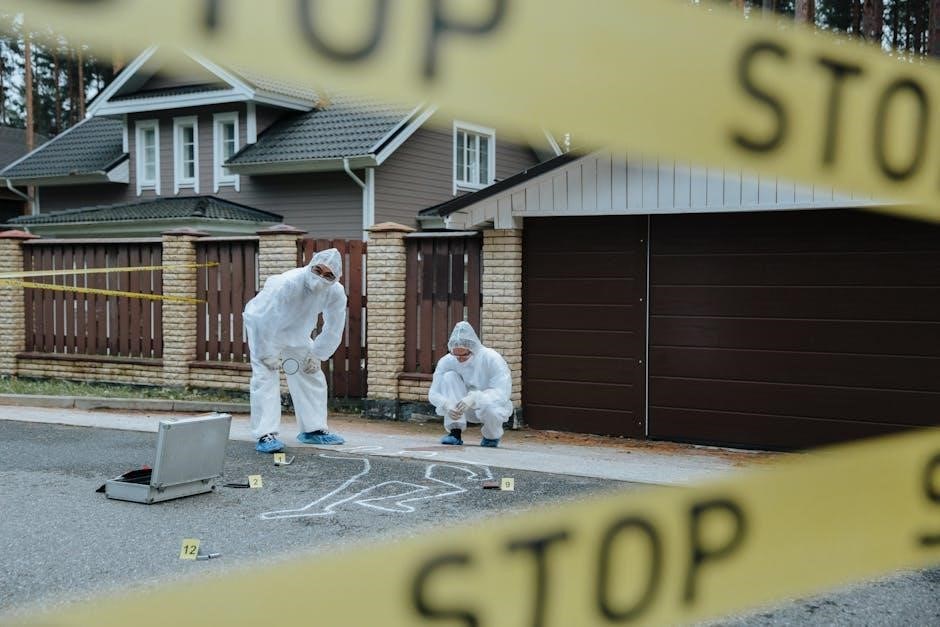
Meticulous crime scene analysis is paramount in homicide investigations, demanding a systematic approach to evidence collection and interpretation. Behavioral evidence, reflecting the actions of both the victim and perpetrator, provides crucial insights into the events leading to the homicide. This includes examining the positioning of bodies, the state of the surroundings, and any signs of struggle or attempts to conceal evidence.
Conjunctive analysis, as highlighted by Chopin (2019), focuses on identifying lethal combinations of crime scene behaviors. This method moves beyond isolated observations to reveal patterns indicative of specific offender characteristics and motivations.
Detailed documentation, photography, and forensic testing are essential components of a thorough crime scene investigation, ensuring the integrity of evidence for subsequent legal proceedings.
A. Behavioral Evidence at Crime Scenes
Behavioral evidence constitutes the cornerstone of reconstructing homicide events, offering a window into the actions and psychological state of those involved. This encompasses a wide range of observations, from the victim’s final movements and interactions to the perpetrator’s methods of operation and post-crime behavior.
Analyzing the spatial relationships between objects and individuals at the scene can reveal crucial details about the sequence of events. Indicators of struggle, defensive wounds, and attempts to stage the scene all contribute to a comprehensive understanding of the crime.
Furthermore, the presence or absence of specific items, coupled with their condition, can provide valuable clues about the offender’s intent and level of planning.
B. Conjunctive Analysis of Crime Scene Behavior
Conjunctive analysis, as highlighted by Chopin (2019), represents a sophisticated approach to crime scene investigation, moving beyond isolated observations to identify patterns of co-occurring behaviors. This method recognizes that homicide is rarely the result of a single action, but rather a complex interplay of factors and decisions.
By systematically examining combinations of behaviors – such as weapon choice, method of disposal, and attempts at concealment – investigators can develop more accurate offender profiles and refine their search strategies. This analytical framework allows for the identification of ‘lethal combinations’ that are statistically associated with specific offender characteristics.
Ultimately, conjunctive analysis enhances the predictive power of crime scene analysis, aiding in both investigation and prevention efforts.
V. Incitement & Assisted Suicide
The intersection of incitement, assisted suicide, and criminal homicide presents complex legal and ethical challenges. Contemporary legal interpretations, as noted in referenced materials, increasingly view incitement to suicide as equivalent to direct commission of criminal homicide, demanding proof of intentionality.
This perspective shifts the focus from the act of self-harm to the culpable actions of the instigator. Assisted suicide, while distinct, also carries significant legal implications, varying considerably by jurisdiction. Determining the line between providing comfort and actively aiding in a suicide is crucial.

Understanding the nuances of these scenarios requires careful consideration of intent, causation, and the specific legal frameworks governing end-of-life decisions.
A. Incitement to Suicide as Murder
The legal classification of incitement to suicide as a form of murder is a developing area of criminal law, demanding meticulous examination of intent and causation. Referenced materials highlight that successfully prosecuting incitement requires demonstrating the perpetrator’s deliberate intent to cause the victim’s death through encouragement or coercion.
This differs significantly from cases involving mere expressions of sympathy or passive acceptance of a suicide plan. Establishing a direct causal link between the incitement and the resulting act is paramount, often requiring evidence of substantial influence over the victim’s decision-making process.
Legal precedents and statutory definitions, like those found in Utah Code, provide crucial context for understanding the parameters of this offense.
B. Legal Implications of Assisted Suicide
Assisted suicide presents a complex legal landscape, distinct from both homicide and fully autonomous suicide, demanding careful consideration of differing jurisdictional laws and ethical considerations. While some jurisdictions decriminalize assisted suicide under specific, tightly controlled circumstances – often involving terminally ill patients – others maintain its classification as a criminal offense, potentially carrying severe penalties.
The core legal distinction lies in the level of active participation by the assisting party. Providing the means for suicide, versus directly administering a lethal substance, significantly impacts culpability.
Understanding these nuances is crucial for investigators and legal professionals navigating cases involving end-of-life decisions and potential criminal liability.
VI. Case Studies & Legal Precedents
Examining real-world homicide cases and relevant legal precedents provides invaluable insight into the application of homicide laws and investigative techniques. A critical example is Utah Code Section 76-5-202 UCA, defining Aggravated Murder as a first-degree felony, illustrated by a case occurring on February 25, 2019, at 7890 South Manzano Drive, Salt Lake City.
Analyzing such cases reveals patterns in offender behavior, evidentiary challenges, and judicial interpretations of key legal concepts. The case of bank robber James Calver, whose photograph appeared alongside a priest’s in police files, demonstrates the diverse backgrounds of homicide perpetrators.
These studies highlight the importance of meticulous crime scene analysis and thorough legal research.
A. Utah Code Section 76-5-202 UCA (HOMICIDE, AGGRAVATED MURDER)
Utah Code Section 76-5-202 UCA meticulously defines the crime of Aggravated Murder, classifying it as a first-degree felony with severe penalties. This statute outlines specific circumstances constituting aggravated murder, demanding a heightened level of intent and premeditation from the perpetrator.
The code details that the offense occurs when an individual intentionally and knowingly causes the death of another person, coupled with specific aggravating factors. A documented case exemplifies this, occurring on or around February 25, 2019, at 7890 South Manzano Drive in Salt Lake City, illustrating the practical application of this legal framework.
Understanding this code is crucial for investigators and legal professionals alike, ensuring accurate charges and just outcomes.
B. Analysis of Notable Homicide Cases
Examining past homicide cases provides invaluable insights into offender motivations, crime scene behaviors, and investigative techniques. The case of James Calver, a bank robber and homicide offender from 1987, exemplifies this. His photograph, displayed alongside a priest’s in police records, highlights the diverse backgrounds of individuals involved in violent crime.
Detailed analysis of such cases, utilizing conjunctive analysis of crime scene behavior – as explored by Julien Chopin in 2019 – reveals lethal combinations of factors contributing to homicide. These analyses extend beyond the immediate act, considering pre-crime behaviors and post-crime actions.

Furthermore, understanding the psychological aspects, as detailed in works from 1987, is crucial for profiling and predicting future offenses.
VII. Psychological Aspects of Homicide
Delving into the psychological underpinnings of homicide is paramount for effective investigation and prevention. Understanding “the criminal mind” – a concept explored in numerous studies – reveals patterns of thought, emotional regulation, and behavioral tendencies that predispose individuals to violent acts. This necessitates a nuanced approach, moving beyond simplistic categorizations.
Profiling homicide offenders, informed by psychological principles, aids in narrowing suspect pools and predicting future behavior. However, it’s crucial to acknowledge the limitations of profiling and avoid reliance on stereotypes.
Factors such as pre-existing mental health conditions, trauma, and social influences all contribute to the complex etiology of homicide, demanding a holistic assessment.
A. The Criminal Mind & Homicide
Exploring the “criminal mind” requires acknowledging the heterogeneity of motivations and psychological states preceding homicide. It’s not a monolithic entity, but rather a spectrum encompassing individuals with varying degrees of psychopathy, antisocial personality disorder, and other mental health challenges. Understanding cognitive distortions, such as rationalizing violence or exhibiting a lack of empathy, is crucial.
Premeditation versus impulsivity significantly shapes the psychological profile. Planned homicides often indicate a calculated, controlling perpetrator, while impulsive acts suggest emotional dysregulation and diminished impulse control.
Early childhood trauma, abuse, and neglect frequently contribute to the development of violent tendencies, impacting emotional regulation and interpersonal skills.
B. Profiling Homicide Offenders
Effective offender profiling relies on a conjunctive analysis of crime scene behavior, victimology, and forensic evidence. It’s a process of inferring characteristics of an unknown subject based on patterns observed at the crime scene, moving beyond simplistic categorization.
Geographic profiling, analyzing the spatial distribution of crimes, can reveal a perpetrator’s anchor points – residence, workplace, or frequent locations. Examining modus operandi (MO) and signature aspects provides insights into the offender’s level of skill, motivation, and psychological needs.
Profiling isn’t about creating a perfect likeness, but rather narrowing the field of suspects and guiding investigative efforts. It’s a dynamic process, refined as new information emerges, and should always be used in conjunction with traditional investigative techniques.
VIII. Technological Tools in Homicide Investigation
Modern homicide investigations increasingly rely on technological advancements for evidence gathering and analysis. Internet speed testing, while seemingly unrelated, can be crucial in digital forensics, establishing timelines and verifying alibis by analyzing online activity.
Digital forensics encompasses the recovery and analysis of data from computers, smartphones, and other digital devices, uncovering crucial evidence like communication records, location data, and deleted files. Historically, signals intelligence played a role, with covert radio agents gathering information – a precursor to modern surveillance techniques.
These tools, combined with advanced DNA analysis and crime mapping software, provide investigators with unprecedented capabilities to solve complex homicide cases and bring perpetrators to justice.
A. Internet Speed Testing & Digital Forensics Relevance
While seemingly peripheral, internet speed testing holds surprising relevance in modern homicide investigations, particularly within the realm of digital forensics. Establishing precise timelines is critical, and network performance data can corroborate or refute suspect accounts of online activity.
Speed tests, like those offered by Speedtest and Xfinity, provide records of upload and download speeds, potentially verifying when files were accessed, transferred, or deleted. This data can be vital in reconstructing a digital footprint and identifying inconsistencies.
Furthermore, analyzing internet connection logs can reveal browsing history, social media interactions, and communication patterns, offering valuable insights into a suspect’s motives and potential connections. Accurate network data is therefore a crucial component of comprehensive digital evidence.
B. Covert Radio Agents & Signals Intelligence (Historical Context)
Historically, signals intelligence played a surprisingly significant, though often overlooked, role in homicide investigations, particularly those involving organized crime or politically motivated acts. During WWII, as detailed by Hebditch (2021), covert radio agents utilized signals to communicate, and monitoring these transmissions offered crucial leads.
While modern technology has evolved, the principles remain relevant. Early forms of surveillance relied on intercepting and analyzing radio communications to identify suspects, track movements, and uncover conspiracies. This historical context informs current digital surveillance techniques.

Understanding how criminals historically exploited communication channels provides valuable insight into potential methods used today, even with advanced encryption. Analyzing past successes and failures in signals intelligence enhances investigative strategies.
IX. Conclusion: Future Directions in Homicide Research
Homicide research demands continuous adaptation, driven by evolving criminal behaviors and technological advancements. Future investigations will increasingly rely on sophisticated data analytics, leveraging behavioral evidence from crime scenes – a conjunctive analysis, as highlighted by Chopin (2019) – and digital forensics.
Improved internet speed testing, like Speedtest, will become integral to establishing timelines and tracing digital footprints. Understanding the ‘criminal mind’ remains paramount, necessitating ongoing psychological profiling and analysis.
Further research into specific homicide types, such as familial homicide and elderly sexual homicide, is crucial. Legal precedents, like Utah Code 76-5-202 UCA, must be continually re-evaluated in light of new evidence and societal changes, ensuring justice and effective prevention strategies.